Parcours client
Livret d'accueil papier ou digital : quel format vraiment utile ?
3
min de lecture
-
13 March 2024
%20(9).png)
In many hotels, the welcome booklet is still there.
Placed on a desk, slipped into a drawer or presented in a filing cabinet, it has been part of the standard for years. It contains essential information: schedules, services, establishment rules, local recommendations.
On paper, it's all logical.
In reality, the question is being raised more and more. Are customers really looking at this booklet? Is it up to date? Is it still fulfilling its role?
And above all: does it really help to make the stay more fluid or has it become a support that is maintained out of habit?
“We've always done it like this... but is it still useful?”
There is no one-size-fits-all welcome booklet model.
The right choice depends above all on three very concrete elements: your customers, your internal organization and the role you want to give to this support in the customer journey.
In some hotels, paper format is still useful. In others, it quickly reaches its limits. So it is not a question of modernity, but of real use.
The welcome booklet is often reduced to a simple information document.
In practice, he plays a much more important role.
It is he who allows the customer to find answers without soliciting the reception. It is also he who makes the services offered visible, and who guides the stay once the customer has settled in.
When effective, it reduces repetitive requests, improves the fluidity of the stay and enhances what you offer.
When it's not, the front desk becomes the focus for all questions, even the simplest ones.

The main advantage of the paper booklet remains its simplicity.
It is immediately accessible, does not depend on a connection, and requires no special effort to be accessed. For some customers, especially those who are less comfortable with digital technology, this remains a reassuring point.
But in practice, its limits quickly become apparent.
A paper booklet is rarely consulted in depth. It quickly becomes obsolete as soon as information changes. It does not allow interaction, reservation, or quick updates. And above all, it no longer corresponds to the current reflexes of travelers.
A customer does not spontaneously look for information in a filing cabinet. He's going to pull out his phone.
This is where the gap is created.
Going digital is not just about replacing a document with a screen.
It changes the way the customer accesses information.
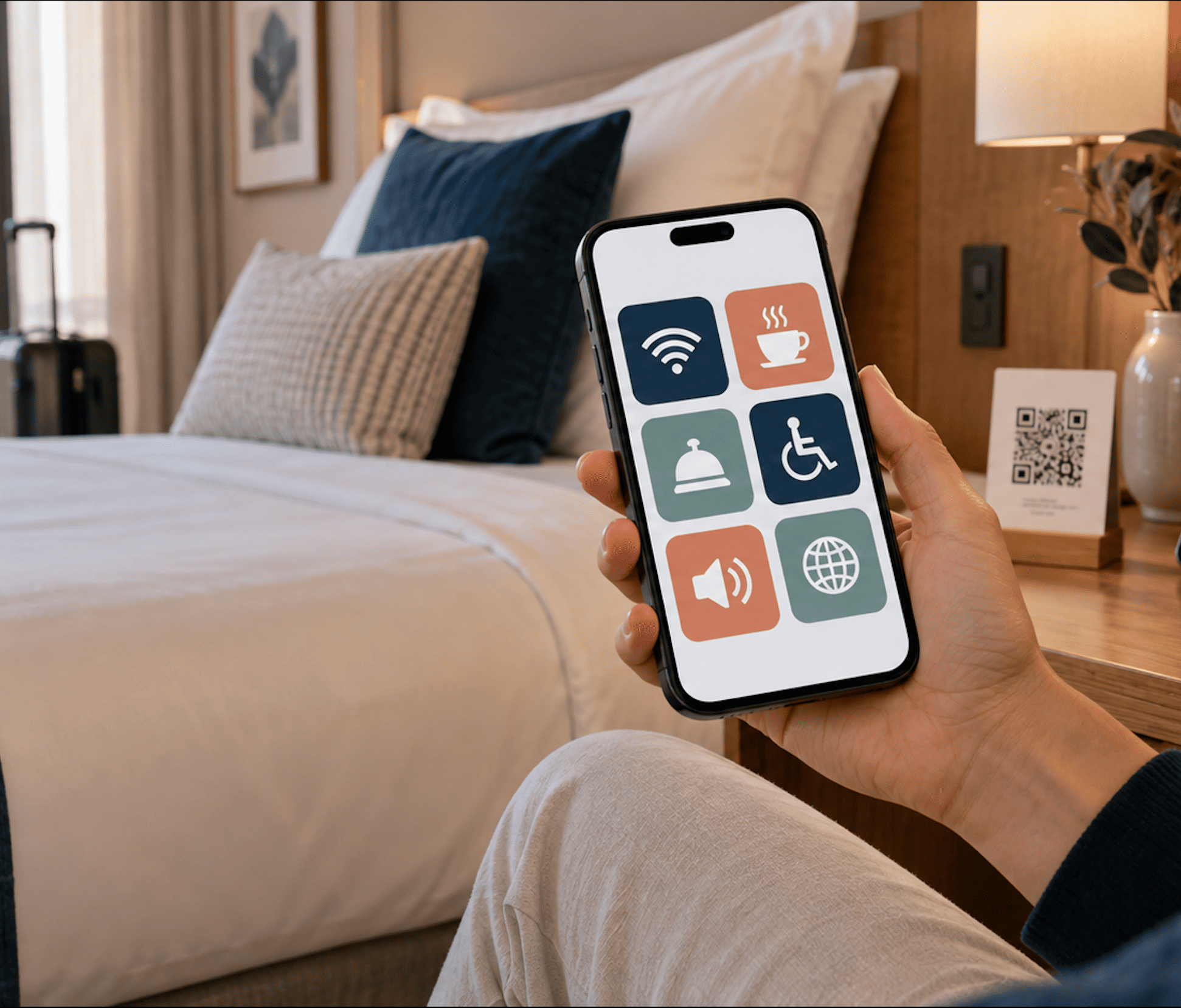
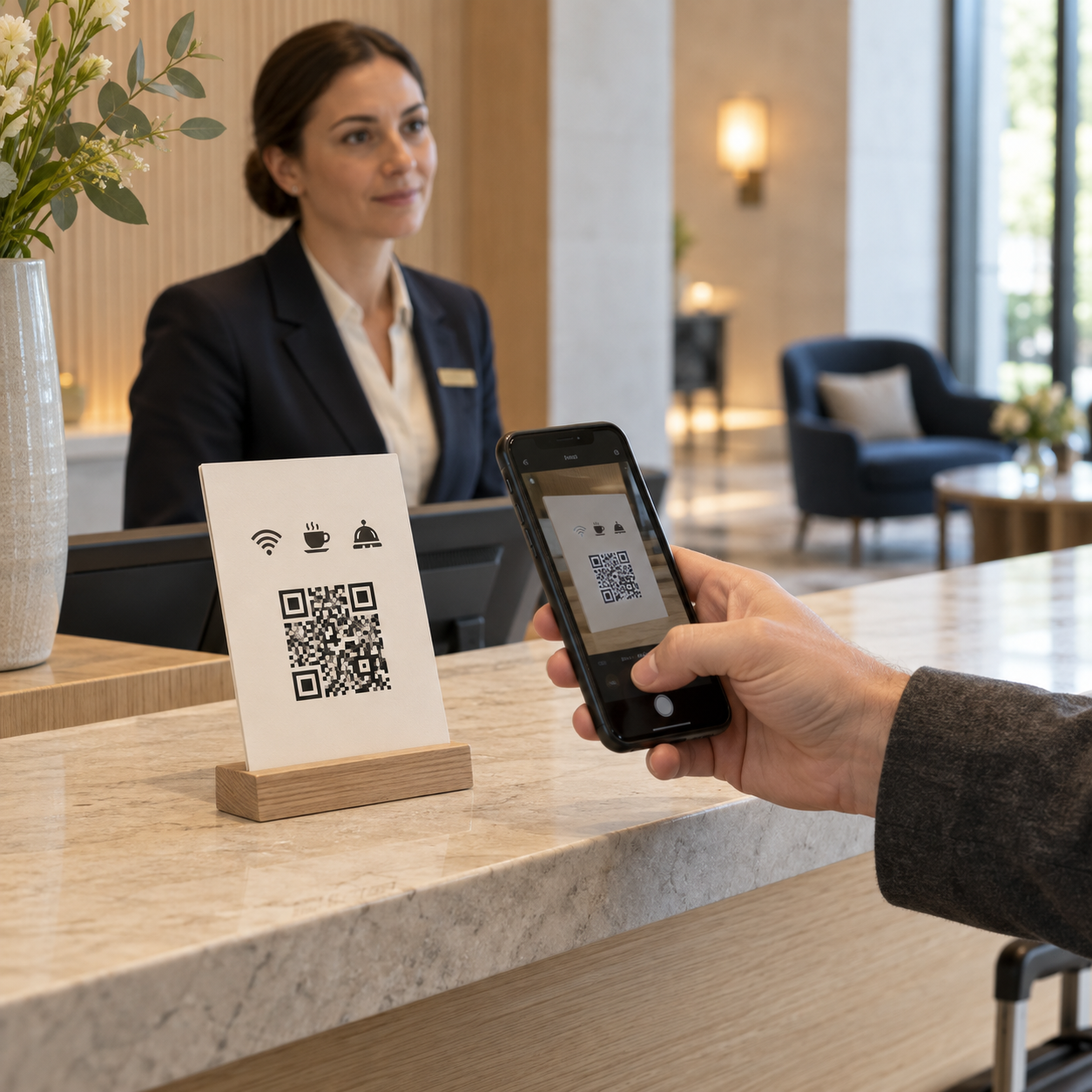
One Digital room directory allows you to access information in a few seconds, from your smartphone, without constraints. It also makes services more visible and easier to activate.
This change is important because it has a direct impact on customer behavior. The simpler the access, the more natural the use.
And the more natural the use, the more the booklet really fulfills its role.
%20(5).png)
What hoteliers are seeing the most quickly is not the “modern” effect of digital technology. It is the operational impact, in particular on manual and repetitive tasks.
Simple requests are decreasing. Teams are less in demand for basic information. Customers are finding their answers without interruption.
This change improves the quality of work on the reception side and the perceived quality on the client side.
The welcome booklet is also a commercial tool for Generate up-sell.
In its paper version, it presents the services. In its digital version, it can go further: make the services visible, understandable and immediately activatable.
It is an important difference.
A service that is not very visible is rarely used. A service that can be reached in a few seconds becomes an opportunity.
It is often at this level that the return on investment comes into play.
Some hotels choose to keep a paper booklet while adding a digital version.
This approach can work in some cases, especially when the clientele is mixed or when the transition must be gradual.
But it also asks a simple question: are both formats really used, or is one of the two quickly becoming secondary?
Multiplying the supports does not guarantee a better experience. What matters is the clarity of the access point for the customer.
They chose to digitize the welcome booklet, making it more fun and searchable at any time.
An urban hotel, a residence, an upscale establishment or an independent hotel in a tourist area will not have the same needs.
The right welcome booklet model is one that:
It is not an aesthetic decision. It is an operational decision.
The welcome booklet remains a key element of the customer experience.
But its effectiveness depends less on its existence than on its actual use.
The paper format is still simple but limited. The digital format brings more flexibility, visibility and operational impact, provided it is well integrated into the customer journey.
So the right choice is not to follow a trend, but to choose the model that is most consistent with your operation.
If your welcome booklet is poorly consulted, difficult to update, or doesn't help reduce front desk requests, there's likely an opportunity for improvement.
Rethinking this medium is not simply modernizing it.
It means improving access to information, making your stay more fluid and improving the value of your services.
GetWelcom allows hotels to transform their welcome booklet into a real operational tool, accessible before, during and after the stay.