Revenus & Getwelcom
Upsell hotel: how to increase your revenue per guest in 2026
3
min de lecture
-
04 July 2024
.png)
In many hotels, the situation is the same.
The rooms are sold, the occupancy rate is ok, but the turnover is capped.
In the field, the reception teams check in one after the other, respond to requests and manage unforeseen events. The customers are there, but a significant portion of the potential remains untapped. The spa is running at half capacity, breakfast is not always booked, some services are simply not consumed.
The problem is not with the offer.
The problem is that customers don't see it at the right time, or don't understand why it's right for them.
This is precisely where upselling becomes a strategic lever. Well used, it makes it possible to increase turnover without recruiting, without increasing room prices, and without increasing the burden on teams.
In many establishments, upselling is still associated with a one-off action. A proposal at the front desk, a suggested upgrade upon arrival, or a list of services posted somewhere in the hotel.
In reality, this approach does not work very well.
A customer who arrives after several hours of transport is rarely in a buying position. He wants to get his key back, put his things down, rest. Offering them an upgrade or an option at that time often creates little value, or even slight friction.
This lag explains why conversion rates are low and why some teams are hesitant to offer additional services.
The real problem is more structural.
The upsell is rarely thought of as a component of hotel customer journey, but rather as an isolated action.
However, a customer is not receptive to the same proposals depending on whether he is booking, preparing his stay, arriving at the hotel or living his experience on site.
Before going any further, it is useful to clarify two concepts that are often mixed.
Upselling consists in offering a higher version of the initial offer. This could be a room upgrade, a specific view, a late check-out, or a more flexible option. The aim is to increase the value of the initial reservation.
Cross-selling, on the other hand, consists in offering complementary services. For example, this includes breakfast, access to the spa, a local activity, a transfer or a catering service.
In fact, these two approaches work together.
Upsell acts upstream on the value of the stay, while cross-sell makes it possible to increase consumption once the customer is engaged.
What makes the difference is not so much the nature of the offer as when it is offered.
One of the main obstacles to upsell performance is bad timing. Offering all offers at the same time, often upon arrival, severely limits their effectiveness.
Before the stay, the customer is in a logic of projection. He prepares for his trip, imagines his experience, anticipates his comfort. This is the best time to offer an upgrade, a premium option, or an improved experience. A well-constructed confirmation email or pre-stay message can generate significant conversions.
During the stay, the logic changes. The customer is already committed to their experience. He is more receptive to proposals related to the present moment: a spa treatment, an activity, a catering service or a local experience. At that moment, relevance and ease of access to the offer are decisive.
After the stay, the objective is no longer to sell immediately, but to prepare for the future. The data collected on the services consumed becomes valuable in order to personalize future communications and encourage a return.
This simple division makes it possible to structure an effective strategy. The upsell works when it fits into the customer's time, not the hotel's.
Another common mistake is to multiply the options in the hope of satisfying all profiles.
Some hotels offer very broad catalogs of services, thinking that this will automatically increase sales. In reality, it often has the opposite effect.
Faced with an overly dense offer, the customer hesitates, delays his decision or gives up. This phenomenon, which is well documented, is linked to the paradox of choice. Too many options make the decision more complex and reduce the need for action.
On the ground, this is reflected in a drop in the conversion rate and a confused perception of the offer.
The most successful institutions take a different approach. They select a limited number of services, but perfectly adapted to their customers. A business-oriented hotel will highlight services related to saving time and efficiency, while a leisure establishment will value experiences and moments of relaxation.
The challenge is not to offer more, but to offer better.
Not all services are the same in terms of conversion.
The offers that work best are those that meet a concrete need or that simplify the stay. A shuttle from the station or the airport, a late check-out to avoid a hasty departure, access to the spa after a busy day or an easily accessible restaurant service are all examples of options that create value.
In some establishments, more specific offers can also perform very well. A pet kit in a pet-friendly hotel, a breakfast box for busy business customers or even local partnerships for activities or events make it possible to differentiate yourself.
What makes the difference is not just the service itself, but how it is presented. High-performing hotels talk more about experience than product. They emphasize comfort, simplicity, pleasure or time savings rather than a simple list of services.
Even with a good selection of offers, a major problem persists in many hotels. If the customer does not see the services offered, he cannot buy them.
However, the reception cannot bear this responsibility alone. Teams are already under heavy pressure and need to manage constant operational priorities.
This is where digital technology plays a structuring role in the customer journey.
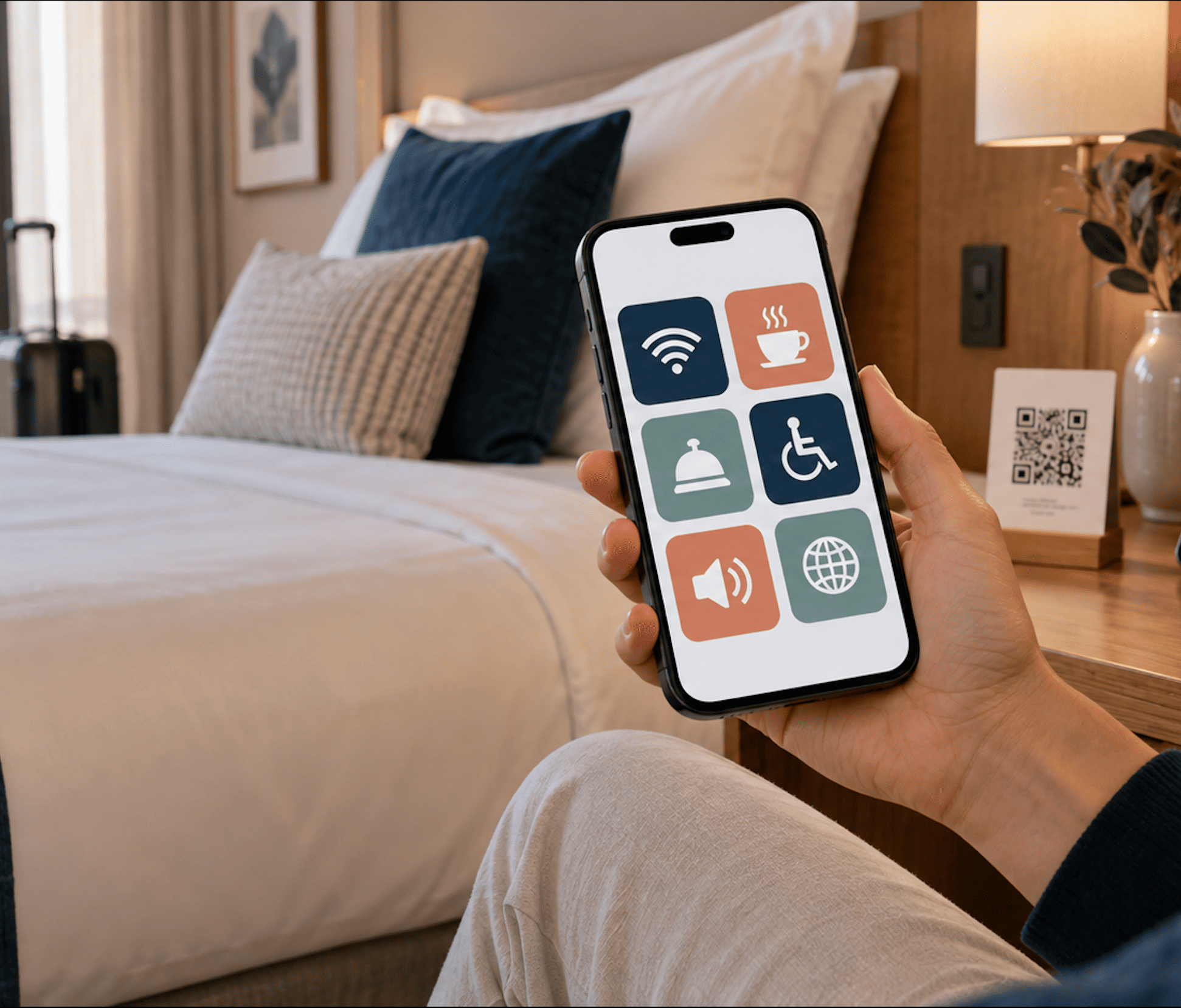
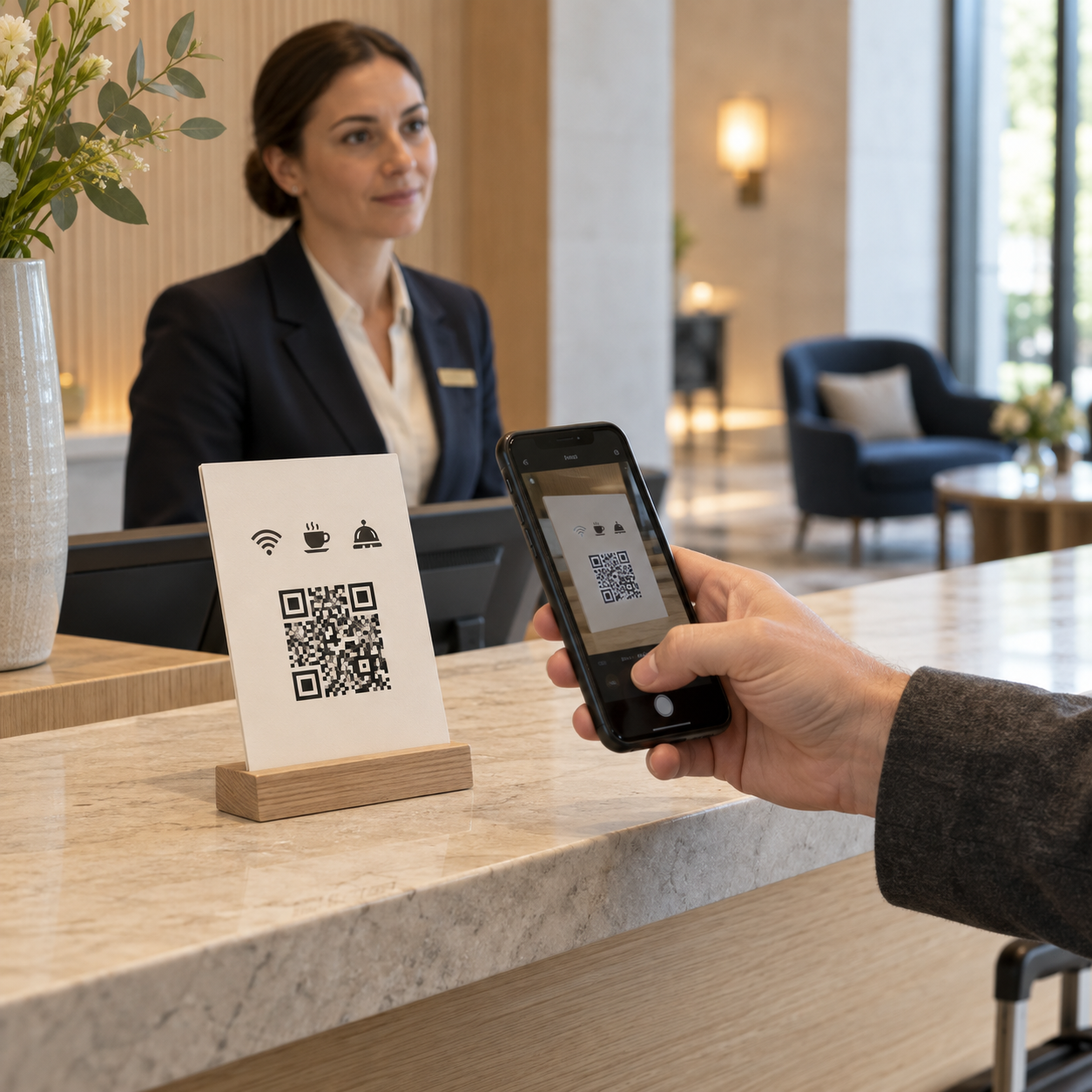
A digital welcome booklet makes it possible to centralize all services and make them accessible at any time. The customer can consult the offers from their smartphone, understand what is offered and book in a few clicks, without waiting for an interaction with the reception.
Unlike a paper medium or a simple oral mention, this type of tool fits naturally into the stay. It accompanies the customer without creating friction and makes it possible to offer offers when they are most receptive.
The result is direct. Better visibility automatically leads to an increase in additional sales, while reducing the pressure on teams.
Hotels that perform on this lever have a different approach.
They don't see upselling as an isolated commercial action.
They integrate it into their organization.
In concrete terms, this means:
This approach makes it possible to increase turnover without adding complexity.
It is based on a simple principle: offer the right offer, at the right time, with the right support.
It is precisely in this logic that GetWelcom is part of, by allowing hoteliers to structure their customer journey, centralize their offers and transform each interaction into a revenue opportunity.
Institutions that perform well on this subject have a structured approach. They don't see upselling as an isolated commercial action, but as a component of the customer journey.
Concretely, this involves several actions. They identify the most relevant services for their customers, structure the moments of communication according to the stay, and rely on supports that make the offers visible without depending on the teams.
They also use customer data to personalize their proposals and refine their strategy over time.
This approach makes it possible to increase turnover without complicating the organization. It is based on a simple principle: offer the right offer, at the right time, with the right support.
GetWelcom is part of this logic, by allowing hoteliers to structure their customer journey, centralize their services and transform each interaction into a revenue opportunity, without burdening the daily lives of the teams.
Upselling is one of the most effective ways to increase a hotel's turnover.
But it only works if it's integrated into the customer journey.
The institutions that succeed in 2026 are those that:
The challenge is not to sell more.
It's about offering better.
Request a GetWelcom demo to see how to effectively structure your upsell strategy in your hotel.