Logiciels & PMS
5 tasks to automate to relieve the hotel reception team
4
min de lecture
-
10 January 2022

Overworked reception: the problem is not always a lack of staff
In many hotels, the same scenario is repeated every day. The front desk manages arrivals, answers the telephone, processes internal requests, processes internal requests, reassures an unhappy customer, relaunches a bill, transmits information to room service, then resumes a check-in that has been interrupted twice in the meantime.
As a result, the burden no longer comes only from the number of customers. It comes mainly from the accumulation of micro-tasks, often simple, but permanent. They are the ones who fragment the day, generate stress and prevent the team from focusing on what really makes a difference in the customer experience: welcoming, listening and the ability to manage sensitive situations.
Automating reception is therefore not about replacing humans. The challenge is more concrete: to take away from teams what takes up their time without creating value.

The tasks to be automated in priority are those that come back in a loop, mobilize teams unnecessarily and can be handled more fluidly by a tool or a digital journey.
In practice, five topics almost always come up:
These are rarely the most visible missions, but they are often the ones that weigh the most on a daily basis.
1. Booking management: an invisible time, but very consuming
We often imagine that the reservation is already largely automated. In reality, in many establishments, it continues to generate a significant load on the reception side.
You have to check a request received by email, confirm a modification, respond to a customer who wishes to cancel, find information in the PMS, check a payment, then make sure that everything is consistent with the other distribution channels. Each action taken separately seems quick. Together, they take up a significant portion of the day.
This is where the wrong level of automation gets expensive. Not only in time, but also in the risk of error. A poorly updated reservation, unsynchronized information or a poorly recorded payment immediately create friction, for the customer and for the team.
The hotels that really save time on this part are the ones that reduce manual manipulations. The customer can book, modify or cancel according to rules defined in advance, while the PMS centralizes and updates the information. Reception then intervenes where it is of real use: special cases, exceptions, sensitive situations.
If there is a stage where the overload is immediately visible, this is it. A queue upon arrival or departure creates tension in a matter of minutes. For customers, it's a feeling of slowness. For the team, it's an accumulation of tasks to be completed quickly, often under pressure.
The problem is not only the time spent. It is also the fact that these moments mobilize the reception on very repetitive actions: verifying an identity, having already known information filled in, explaining practical elements, handing over a key, cashing in, editing an invoice.
Some of this work can be moved prior to arrival or simplified at the time of stay. This is what allows the reception to regain availability instead of absorbing peaks of activity that are difficult to smooth out.
One online check-in Well thought-out is not just about making things modern. It is used to prevent the arrival of the customer from starting with waiting and administrative procedures. The same logic at the beginning: the more anticipated, clear and accessible the bill is, the less the check-out monopolizes the team.
Les additional sales still rely too often on the availability of the receptionist at the right time. In theory, the team should offer breakfast, an upgrade, a late check-out, an activity or a service. In practice, it depends on the flow, the time available, the level of customer information, and the ability to not seem pushy.
This is precisely why this subject benefits from being better structured.
Automation does not replace the commercial role of the front desk. It sets the stage. It makes it possible to display the right services at the right time, to make the offer legible, to highlight certain opportunities even before the customer goes to the desk. Then, the team can get back in control with more relevance, because the context is better.
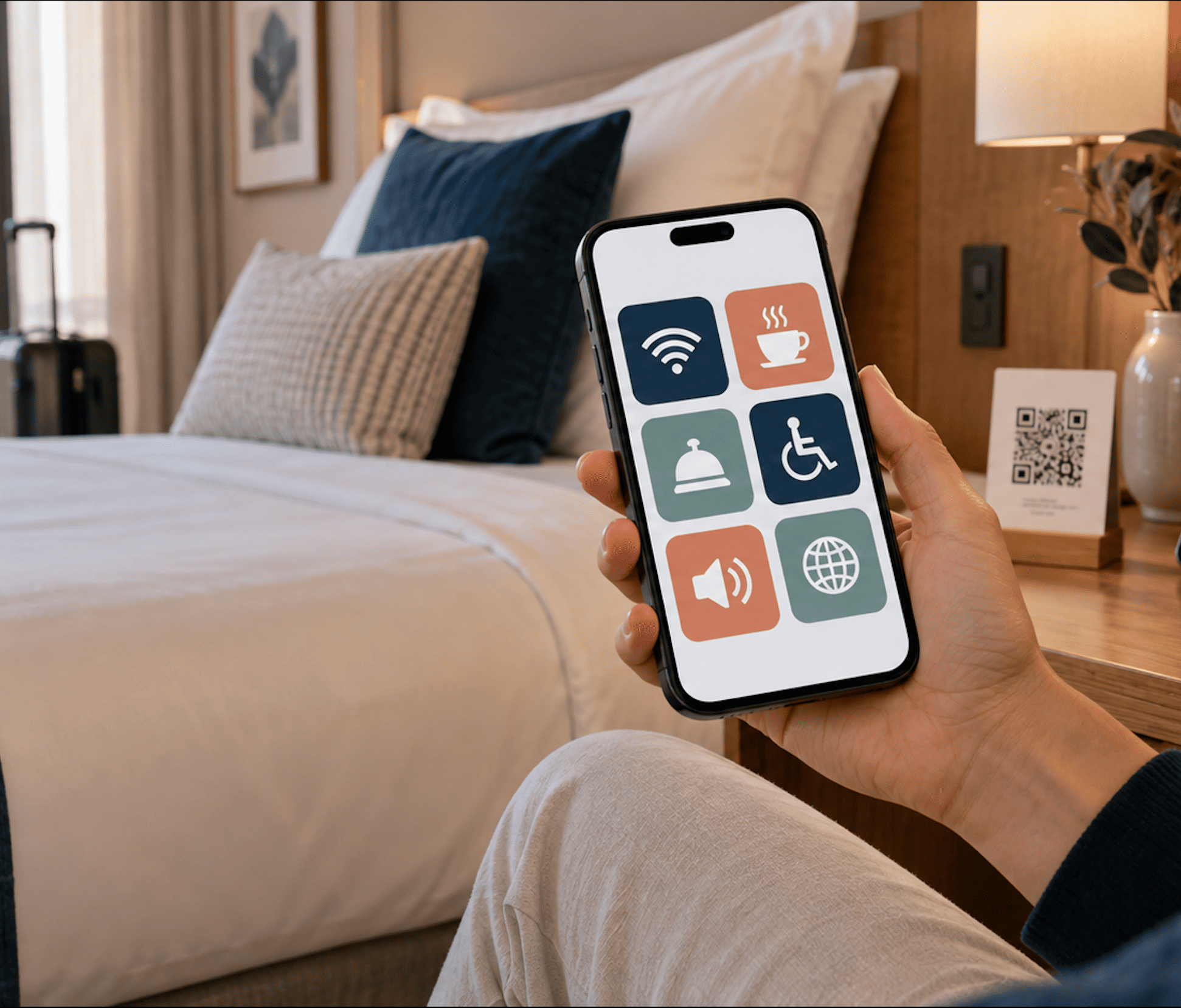
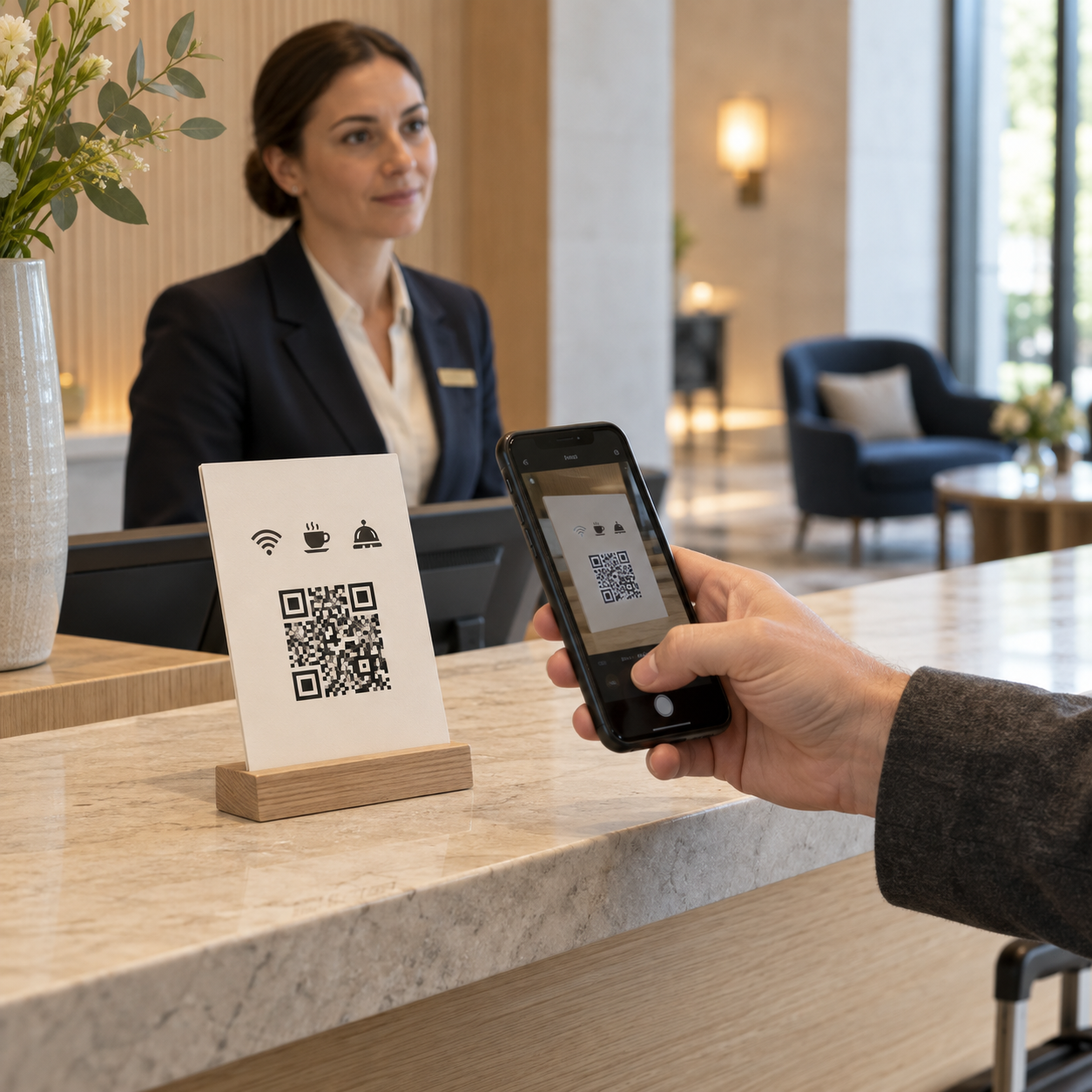
One Digital room directory, for example, is not only used to inform. It becomes a medium to make services visible, understandable and bookable effortlessly. This prevents the reception from having to carry everything alone, while increasing the chances of the customer taking action.
The Wi-Fi code, breakfast schedule, departure time, departure time, parking, room service, recommendations around the hotel... none of these requests is problematic in itself. But their repetition ends up weighing heavily.
This is often where the front desk wastes the most time without it being clearly shown in the schedules. One minute here, two minutes there, several dozen times a day. All in all, this is a considerable burden.
Automating this part does not mean cutting off the link with the customer. It means making information available before they need to contact someone.
This generally involves two things: useful communications sent at the right time, and easy access to information during the stay. When a customer finds their answer in a few seconds on their phone or in a clear space, reception no longer needs to serve as a permanent information standard.
It is also one of the best ways to reduce operational fatigue without affecting the quality of service.
When we talk about automation at the reception, we think of the customer first. However, an important part of the burden also comes from internal exchanges.
The reception must warn the floors, relay a maintenance request, report an early arrival, send instructions to the restaurant, send information to the management. If these exchanges are based on calls, scattered messages, or constant back and forth, reception becomes a saturated hub.
The problem isn't just volume. It's the absence of fluidity. Information that is poorly transmitted or transmitted too late leads to errors, oversights or tensions between departments.
Digital tools bring real value here when they allow you to centralize requests, assign actions and keep a clear record of what has been done. From then on, reception is no longer obliged to act as an intermediary on each micro-subject. It is once again becoming a pilot point, not a bottleneck point.
Not all hotels need to automate the same things at the same pace. On the other hand, it's generally useful to start with tasks that combine three criteria: they come up often, they cut the day off, and they don't require real relational value.
In practice, this often means starting with:
These are the levers that produce the most visible gains in a short period of time.
This is often the initial fear, especially in establishments that place a lot of importance on the quality of welcome. However, in the field, the observed effect is generally the opposite.
When repetitive tasks decrease, teams have more availability to genuinely welcome, resolve complex situations, personalize the exchange and better support customers. Automation doesn't take away the relationship. She removes what is suffocating her.
This is also where the balance comes in: using digital technology to treat what does not need humans, in order to give space to those who need it.
An overwhelmed reception is not always a sign of being understaffed. This is often a symptom of an operation where too many simple tasks continue to be managed manually.
By automating reservations, check-in, check-out, recurring requests, the promotion of services and internal exchanges, a hotel can recover time, reduce operational pressure and improve the perceived quality of the stay.
The real aim is not to do more with less. It is to allow the reception to finally focus on its true role.
If your reception team still spends a large part of their day repeating information, managing micro-administrative tasks, and moving information between departments, there is likely to be real potential for optimization.
GetWelcom helps hotels automate the right touchpoints in the customer journey to relieve teams, streamline operations and give time back to the relationship.