Logiciels & PMS
Digital guest directory: how to make it accessible to everyone?
5
min de lecture
-
05 October 2026
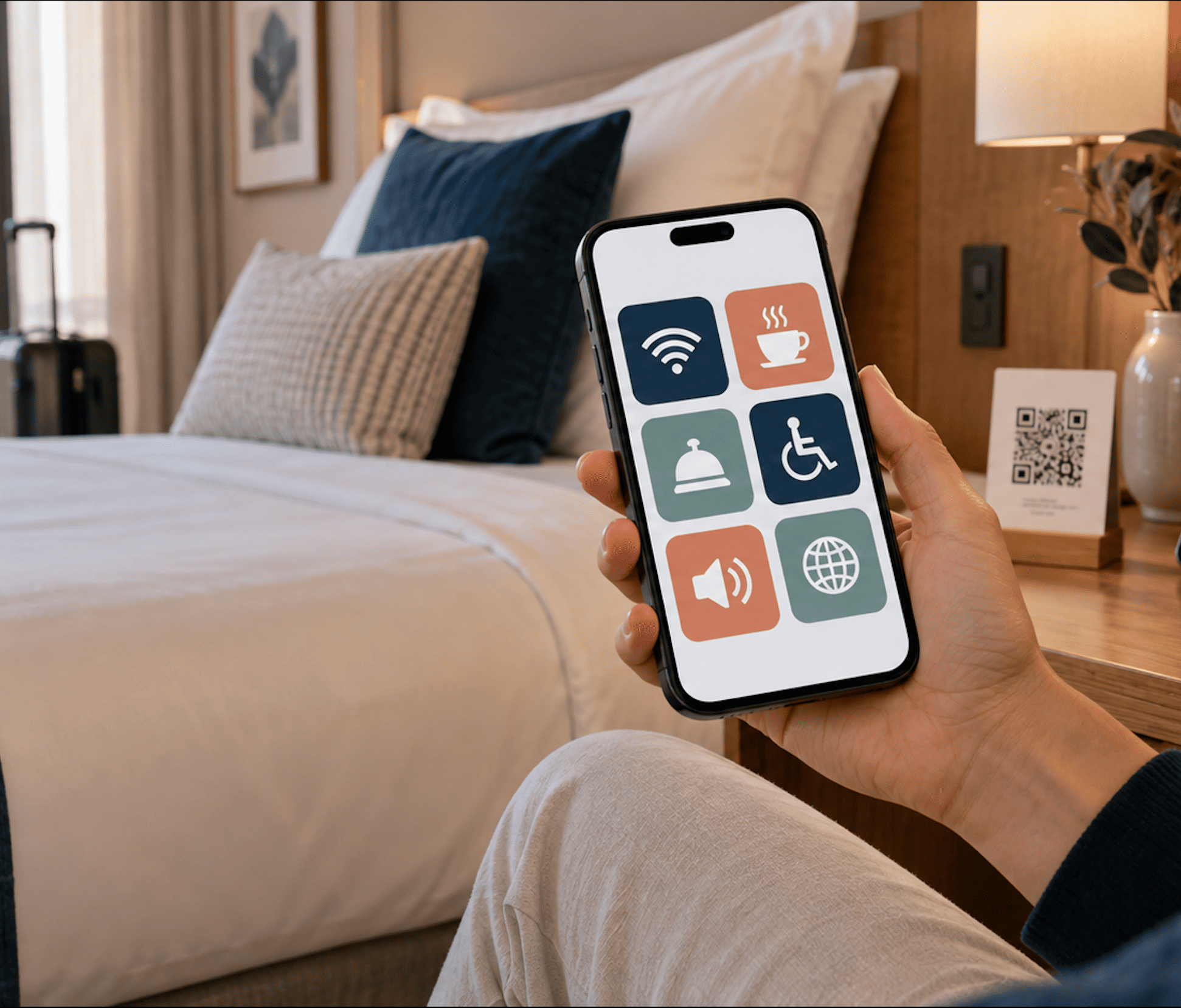
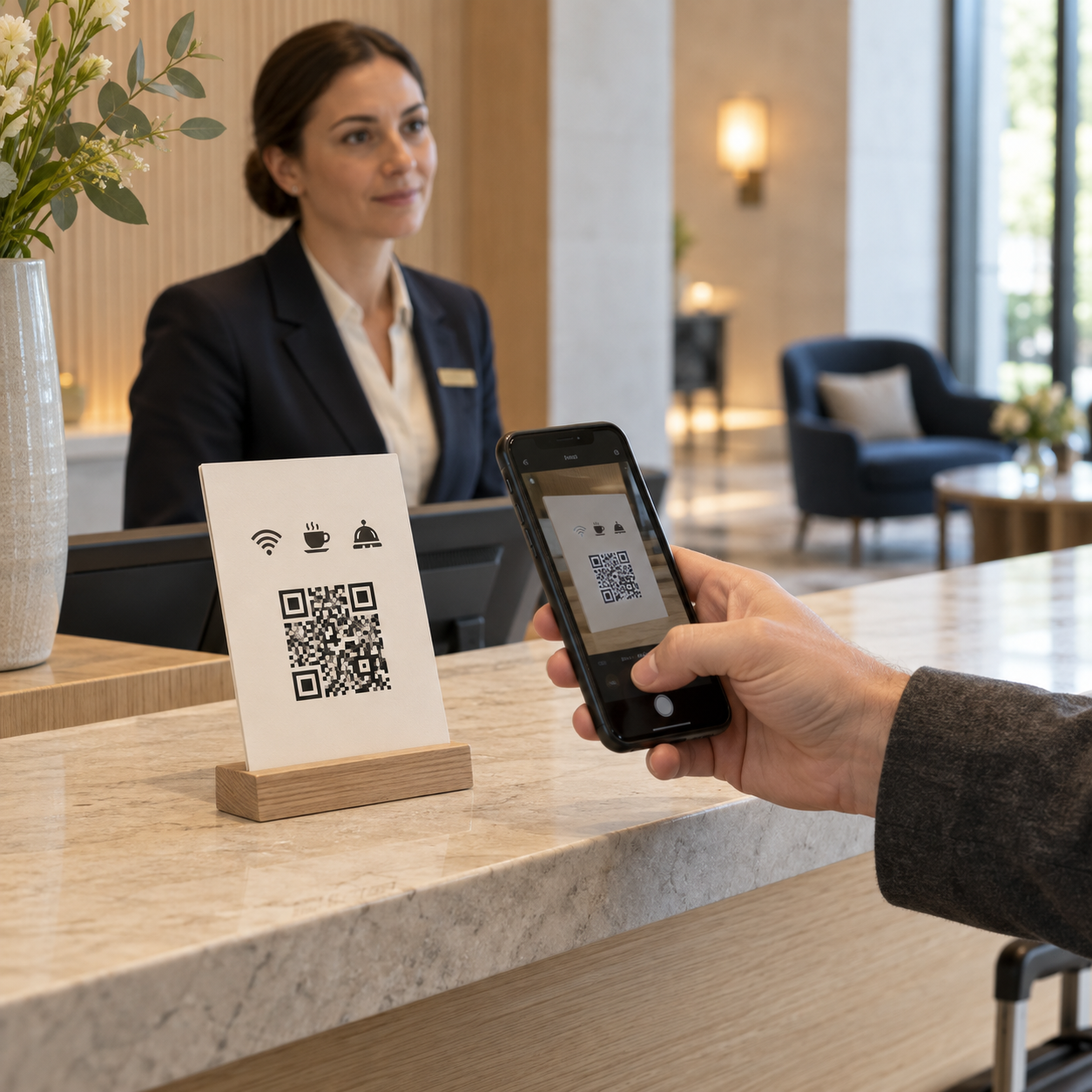
A guest scans the QR code in their room. The guest directory opens, but the text is too small. Another traveler uses a screen reader. A third doesn't speak French. Yet another simply doesn't have a smartphone available.
In these situations, digitizing the directory isn't enough to ensure that everyone can actually access the hotel's information.
Making a digital guest directory accessible isn't just about providing a QR code. You also need to consider readability, navigation, languages, various disabilities, and alternative solutions when a smartphone isn't suitable.
The QR code remains one of the easiest ways to open a digital guest directory from a room, reception, or common area.
But some travelers may have difficulty scanning it. Others may have a dead battery, rarely use their smartphone, or want to check information before they arrive.
A digital room directory is therefore more effective when it can be accessed in several ways: via a QR code, but also through a link sent before the stay or provided by the front desk.
GetWelcom actually recommends making the room directory visible at different stages of the stay to facilitate its use, rather than relying solely on a QR code in the room. (getwelcom.com)
This approach simply gives the guest more ways to access the same information depending on their situation.
Once the booklet is open, accessibility depends heavily on how the interface was designed.
Fonts that are too thin, light gray text on a white background, or small buttons can quickly make browsing difficult.
Digital accessibility standards provide several useful benchmarks. The RGAA, for instance, recommends a contrast ratio of at least 4.5:1 for most standard text and requires that content remains usable when the text size is increased by up to 200%.
Navigation must also remain intuitive.
A button labeled "Book the spa" is more explicit than "Learn more." Sections should follow a logical structure, and important actions should be easy to identify.
For users relying on screen readers, meaningful images must have relevant alternative text, and buttons or links must have clear labels. Features must also be usable without relying solely on specific gestures or complex interactions. Official digital accessibility principles emphasize four dimensions: a service must be perceivable, operable, understandable, and robust, particularly regarding assistive technologies.
This approach is a direct extension of the Room Directory's role in the guest experience : making information available is not enough if the guest cannot actually use it.
Digital tools simplify access to information for the majority of travelers, but they must not become a barrier for those who cannot or do not wish to use them.
The hotel must therefore be able to offer an alternative way to obtain essential information.
This can be handled by the reception team, through essential information provided in another format, or via a device made available when the establishment's layout allows it.
This is particularly important for information essential to the stay: opening hours, safety, how to contact the team, access to services, or how to use certain equipment.
Regulations regarding public-access buildings also state that these establishments must ensure that people with various types of disabilities can access the services and information provided by the establishment.
The right approach is therefore to ask yourself:
Digital tools should add an access option, not remove others.
Accessibility also concerns comprehension.
An international traveler may be able to access the Room Directory very easily while still struggling to understand the information if it is only available in French.
Multilingual support is therefore essential.
The automatic translation of the Room Directory allows you, for example, to present content in the guest's language and synchronize translations whenever the original information is updated.
But word-for-word translation is not enough.
Short titles, simple sentences, and concrete vocabulary make content easier to understand in any language. A section titled "Breakfast" will generally be easier to identify than a more creative marketing title.
The same logic applies to content organization. The article on information to include in a hotel guest directory helps identify useful content; the challenge of accessibility is then to prioritize it so that it can be found quickly.
This logic aligns more broadly with best practices in hotel communication, where the clarity of the message matters just as much as the channel used.
Several regulatory frameworks may come into play, and they do not apply to all establishments in the same way.
A hotel is a public-access building (ERP) and must comply with accessibility requirements applicable to the facility and access to its services. However, this does not mean that all private hotels are automatically subject to RGAA for all their digital assets.
The scope of the RGAA primarily concerns public organizations and certain large private companies. For the latter, the current threshold is based on an average of €250 million in annual turnover generated in France over the last three closed financial years.
Since June 28, 2025, another framework has also applied to certain digital products and services following the European Accessibility Act. The DGCCRF specifically cites e-commerce services and clarifies that booking a hotel room online is one of the situations covered. Exemptions exist, particularly for certain micro-enterprises providing services.
A purely informational Room Directory does not necessarily fall under the same scope as a booking engine.
However, when a digital environment also allows for booking or purchasing services, its functional scope deserves careful examination.
For an establishment not legally subject to the RGAA, its criteria still remain an excellent benchmark for best practices for designing a service that is usable by more customers.
A journey that seems obvious to the team that designed it is not necessarily so for a traveler discovering it for the first time.
Before deployment, a few simple tests can quickly identify potential issues.
Increase the text size to 200%. Try navigating without using only a mouse. Turn on a screen reader. Change the language. Test the display on a small screen and with a slower connection.
You can also ask someone unfamiliar with the Room Directory to find three simple pieces of information: the Wi-Fi details, breakfast hours, and how to contact the front desk.
If this information requires multiple steps or is difficult to find, the content organization likely needs to be simplified.
Beyond compliance issues, this approach also helps reduce friction during the stay and contributes directly to the guest satisfaction in hotels.
GetWelcom centralizes hotel information and services into a digital room directory accessible from the guest's smartphone, with no app to download, featuring translated content and centralized updates.