E-réputation et communication
Fake Google, Booking, or TripAdvisor reviews: what can a hotel actually do?
5
min de lecture
-
07 October 2026

A one-star review appears on Google. No one on the team recognizes the stay described. The name doesn't match any booking, and some details even seem to concern a different establishment.
The first instinct: wanting to make it disappear.
In practice, a hotel cannot delete a review posted on Google, Booking.com, or TripAdvisor itself. It can verify the facts, report the content when it violates the platform's policies, and manage its public response during the review process.
This reaction is part of a broader strategy forhotel online reputation management : the goal is not just to manage a rating, but to protect the trust of travelers who check reviews before booking.
A very negative comment is not necessarily a fake review.
Start by searching for information available in your PMS, OTA bookings, emails, and any exchanges with the front desk.
The publicly displayed name is not always enough to draw a conclusion. The traveler may be using a pseudonym, may have booked under someone else's name, or may be part of a group booking.
Instead, compare the concrete details mentioned in the comment: dates, room category, services used, the incident described, or interactions with staff.
Then, save a screenshot, the URL of the review, its date, and any elements that could support your request
If the stay or the incident seems real, treat the comment as customer feedback, even when some details seem inaccurate to you. Monitoring customer satisfaction helps identify pain points and recurring issues in guest feedback.
When the available evidence suggests content is unrelated to a real experience or violates publication guidelines, reporting it becomes appropriate.
Policies vary by platform, but several common grounds for removal include: fake content or spam, comments unrelated to the experience, threats, harassment, hate speech, impersonation, or the disclosure of personal information.
On Google, only reviews that violate policies are eligible for removal. A simple disagreement between the business and the customer is not enough, on its own, to secure a removal.
Booking.com also provides for the moderation of fake or misleading content, spam, threats, certain offensive content, and privacy violations.
TripAdvisor applies its own standards and may remove a comment that violates them. However, the platform leaves factual disagreements between an establishment and a traveler outside of this moderation process.
Before reporting a review, it is therefore useful to identify the specific rule that may have been violated and to gather the evidence that supports your claim.
On Google, reporting is done via the Google Business Profile or the review management tool.
The establishment selects the relevant comment, chooses the corresponding reason, and submits the request. Google then reviews the content and allows you to track the status of the report through its dedicated tool.
If the review remains published, the hotel can check the appeal options available in its interface.
During this review process, the Google listing remains visible to travelers. A public response can therefore still be useful.
For example:
"We have checked our records but cannot find a stay corresponding to this situation. We remain available to discuss this directly and clarify this feedback."
This phrasing states the hotel's position factually, without publicly calling the author into question.
The GetWelcom article dedicated toimproving Google and TripAdvisor ratings provides a more detailed look at best practices for managing reviews and protecting your online reputation.
Booking works differently than Google, as reviews are linked to the booking process on their platform.
Booking states that a traveler can post a review if they have booked through the platform and stayed at the property, or if they arrived at the property even if the stay did not ultimately take place.
Therefore, the phrase "this person did not stay with us" is not always enough to invalidate a comment.
If a review contains spam, fake content, impersonation, privacy violations, or any other element that goes against the rules, it can be reported to Booking so the situation can be reviewed.
Here, the most effective approach is to precisely identify what violates the content policy, and then provide the available evidence to allow the platform to verify it.
This difference between Booking and Google is significant: the traveler verification process is not the same, so the hotel's argument should not be the same either.
On TripAdvisor, a property can report a comment it considers to be in violation of the rules.
TripAdvisor states that content is removed when it violates their standards or when a problematic element is proven. However, the platform also recommends that properties post a response when the review remains visible, so that travelers can see both sides of the story.
This logic makes public responses particularly important.
Centralized management makes this work easier. The GetWelcom feature for review centralization and response gathers comments from Google, TripAdvisor, Booking, and other OTAs, saving teams from having to monitor each platform separately.
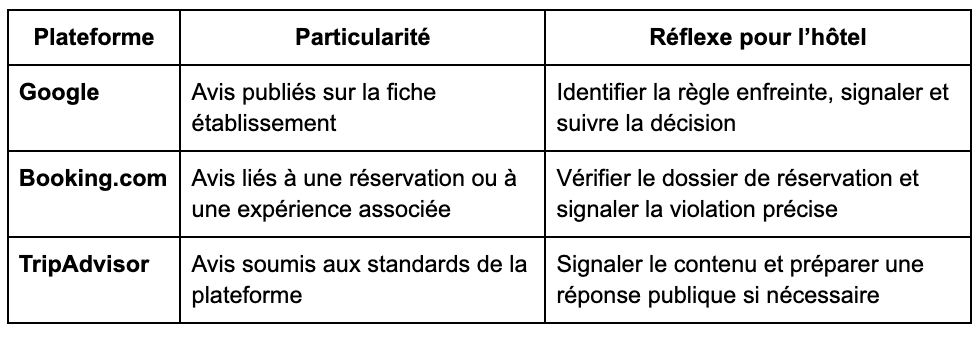
The common rule remains simple: the hotel builds the case and reports it; the platform decides on moderation.
A public response is most effective when it remains brief, factual, and solution-oriented.
Personal information from your PMS, specific stay dates, or other details that could identify the guest should be kept out of your public response.
Direct accusations should also be avoided:
"You are lying"
"You have never been a guest at our property"
"This review is fraudulent"
Even if your team is convinced that a comment is problematic, this type of response can make you appear defensive to other travelers.
Wording like this is generally more appropriate:
"We are unable to locate the situation described with the information provided. We invite you to contact us directly so that we can look into what happened."
A public response provides context, while private communication is used to verify facts and address the issue if necessary.
This separation aligns with the principles of hotel communication tailored to the right channel.
Some situations go beyond the standard management of a negative review: threats, blackmail, extortion attempts, the disclosure of personal information, or a coordinated series of suspicious comments.
In such cases, start by preserving evidence before taking any action: take screenshots, save URLs, note dates, and keep any messages received.
Then, use the appropriate reporting channel on the platform for the specific issue.
If the content raises real legal or security concerns, it may be necessary to seek professional advice rather than treating the situation solely as an online reputation issue.
Google also has a specific process in place for when a Business Profile is targeted by extortion attempts using negative reviews.
Managing fake reviews is essentially reactive. Hotels can also work proactively on feedback from genuine guests.
An in-stay survey can, for example, help identify dissatisfaction while the traveler is still on the property. The team can then understand the issue and intervene before they check out.
The hotel NPS provides another perspective: it helps track the guest experience and identify satisfied or dissatisfied customers at different stages of their journey.
After the stay, the goal shifts. Guests who have actually experienced the stay can be invited to share their feedback at the appropriate time.
The choice of timing, channel, and wording is detailed in our article on requesting customer reviews.
This approach obviously won't make an already published fake review disappear. However, it does help build an online reputation based on a steady stream of authentic feedback, rather than relying on a few isolated comments.
GetWelcom gathers reviews from Google, Booking.com, TripAdvisor, and Expedia into a single interface to make tracking and responding easier for your team.