E-réputation et communication
How to sustainably improve your Google and TripAdvisor ratings
5
min de lecture
-
13 August 2026

Monday morning. A hotel manager opens Google and TripAdvisor after a busy weekend. Two new negative reviews have appeared.
One mentions a room that was too hot. The other, a request that went unanswered during the stay.
In both cases, the issue could potentially have been resolved before the guest checked out.
But the team only found out about it once the review was posted.
This is where a large part of a hotel's online reputation is won or lost. Improving your hotel's Google and TripAdvisor ratings is not just about asking for more 5-star reviews. You must take action across the entire chain: customer experience, identifying pain points, collecting reviews, responding, and analyzing feedback.
Google and TripAdvisor work differently, but both value a reputation built over time. Google specifically notes that the number of reviews and positive ratings can contribute to a business's local ranking. On TripAdvisor, the popularity index takes into account the quality, quantity, and recency of reviews.
The rating is therefore not the starting point of the strategy. It is the result of the experience lived by the guest and how the hotel manages that experience.
On Google, reviews appear directly in the business profile, Google Maps, and search results. They therefore play a dual role: providing reassurance to the traveler and local visibility for the hotel.
Google explains that its local ranking is primarily based on three factors: relevance, distance, and prominence. The number of reviews and positive ratings are among the elements that can contribute to this prominence.
TripAdvisor follows a different logic. Travelers go there more to compare properties and plan their stay. Its popularity index takes into account, in particular, the quality of ratings, the quantity of reviews, and their recencyRecent reviews carry more weight than older ones when it comes to reflecting the experience an establishment offers.
In either case, a sustainable strategy is not about triggering a one-off wave of positive reviews. It is about creating the conditions to consistently receive feedback that represents an improving customer experience.
A bad review usually doesn't start the moment a guest opens Google or TripAdvisor. It starts earlier.
A room that's too hot. Unstable Wi-Fi. A forgotten towel request. Information that's hard to find. A check-in process that takes too long.
Taken individually, these irritants may seem minor. But when they aren't addressed during the stay, they sometimes become the main focus of the review posted after departure.
The first step, therefore, is to detect dissatisfaction while there is still time to act.
A survey sent during the stay can, for example, ask guests if everything is going well and immediately flag an issue to the front desk. A team informed in time can step in, offer a solution, and most importantly, prevent the guest from spending the rest of their stay with unresolved frustration.
With theGetWelcom in-stay survey, guests can be automatically prompted via email, SMS, WhatsApp, or OTA messaging. When dissatisfaction is reported, teams can be alerted and intervene before the guest checks out.
The goal is not to make bad reviews disappear. It is simpler: reduce the reasons that can lead to a bad review.
That is a fundamental difference.
A successful experience does not automatically generate a review.
A guest can be very satisfied with their stay, hand back their key, catch their train or plane, and not think about the hotel again a few hours later.
Collection must therefore become a natural step in the customer journey, rather than a one-off task performed by the front desk.
This journey actually begins long before the review request is sent.
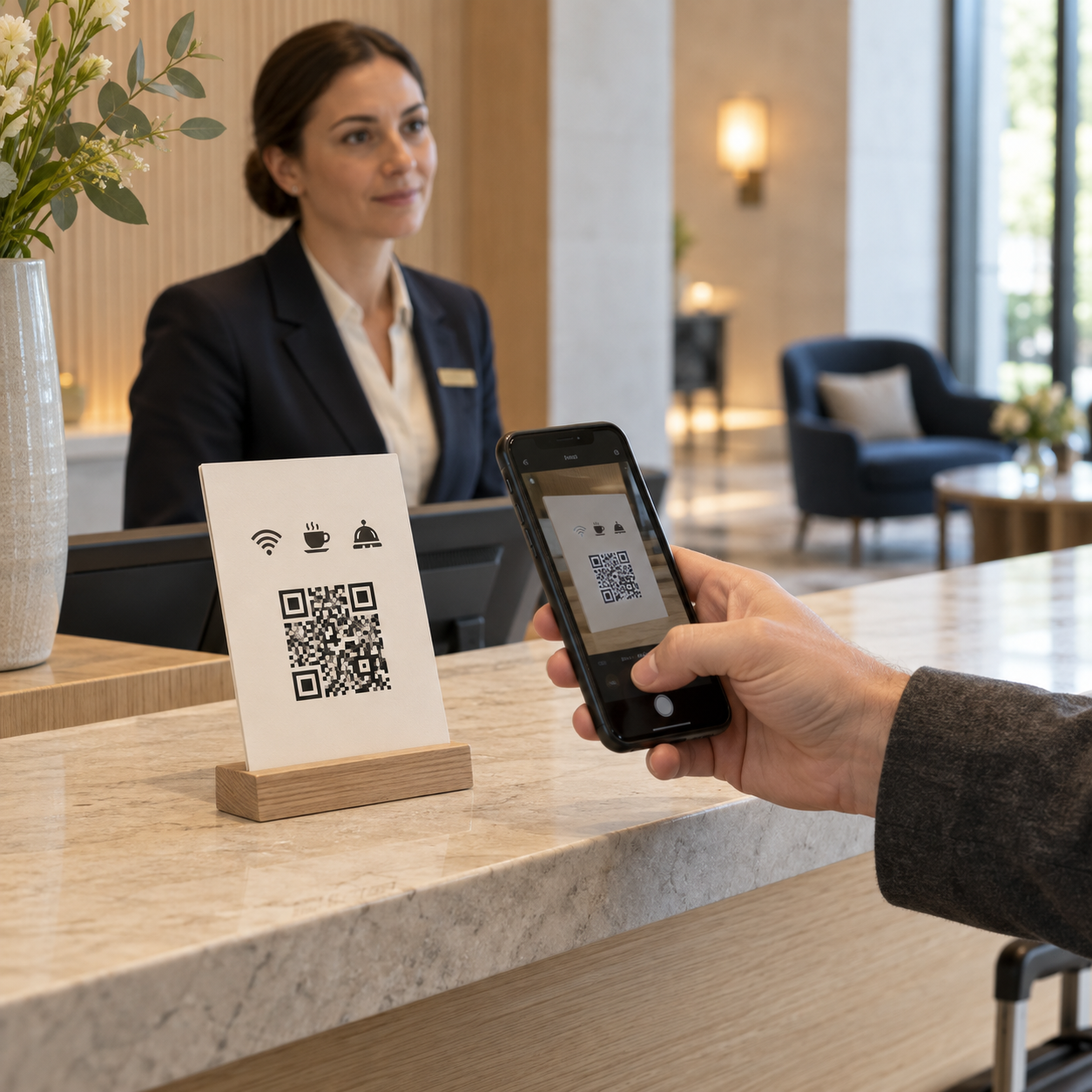
Before the stay, communication and digital check-in help prepare for the traveler's arrival.
During the stay, the hotel can stay in touch, provide easy access to the information and services the guest needs, and gauge their satisfaction level.
After departure, an automated request can be sent to gather feedback and continue the journey through to sharing their experience on Google or TripAdvisor.
With GetWelcom, these various touchpoints can be unified into a single journey. The hotel doesn't start working on its online reputation the moment it asks for a review: it builds it throughout the entire guest experience.
The timing of the request also remains important. At check-out, travelers are often thinking about their bill, their luggage, or their transport. Several days later, the details of the stay begin to fade.
A post-stay request allows you to contact the guest when their experience is over but still fresh in their mind. The message should remain simple, personalized, and easy to complete. To take it a step further, the right time to request a customer review depends largely on the guest journey and the specific context of the establishment.
Collection thus becomes consistent, integrated, and much less dependent on manual tasks by your team.
Getting a review is only half the job.
A response posted on Google or TripAdvisor isn't just for the customer who wrote the review. It can be read by every traveler who checks your business profile afterward.
In fact, Google encourages businesses to respond to reviews, noting that helpful responses show customers that their feedback is valued.
The 2026 annual benchmark by Shiji, based on over 40 million reviews from 12,000 hotels, reported a global hotel response rate of 68.8% in 2025, with an average response time of 3.5 days.
Avoid generic, copy-paste responses like:
"Thank you for your feedback, we look forward to seeing you again."
A more personal response highlights a specific detail from the stay: the breakfast, the welcome, the room, the location, or even a staff member mentioned by the guest.
A few lines are enough. The goal is simply to show that the review was actually read.
The goal is not to have the last word.
An effective response can follow four steps:
Acknowledge the feedback → Address the specific issue → State what has been checked or corrected → Offer to take the conversation offline if necessary.
Avoid defensive responses, lengthy justifications, or copy-pasted templates.
Keep in mind that your response is not just for the unhappy guest. It also reassures future travelers who will read the exchange before booking.
An average rating indicates a general level of satisfaction. Comments help you understand what lies behind it.
If several travelers repeatedly mention noise, cleanliness, bedding, breakfast, Wi-Fi, check-in, or wait times at the front desk, the issue is no longer just about communication or online reputation.
It becomes an operational problem.
This is why reviews must be analyzed over time.
A hotel can track, for example:
The question to ask is no longer just:
"Why did our rating drop from 4.4 to 4.3?"
Instead:
"What themes have been recurring in customer feedback over the last three months, and what operational actions can we implement?"
Online reputation then becomes a management tool, not just a marketing metric.
Things get complicated when an establishment has to monitor Google, TripAdvisor, Booking.com, and Expedia separately.
A response might be forgotten. A platform might go unchecked for several days. And as the number of reviews grows, it becomes increasingly difficult for teams to maintain a comprehensive view of customer satisfaction.
Being present on multiple platforms isn't the problem. It’s managing them across several separate interfaces that leads to inefficiency.
The centralization of reviews with GetWelcom allows you to consolidate reviews from Google, TripAdvisor, Booking.com, and Expedia into a single interface, making it easy to view, filter, and manage responses from your back-office.
Automation can also handle repetitive tasks: sending surveys, triggering alerts for negative feedback, centralizing responses, and tracking key metrics.
But it cannot replace human decision-making.
A poorly cleaned room requires action. A complex comment deserves a personalized response. A problem mentioned fifteen times in one month requires a management decision.
Technology should therefore automate detecting and organizing information, to give teams time to take action.
Ultimately, sustainably improving your Google and TripAdvisor ratings relies on a simple loop:
Experience → Detecting pain points → Intervention → Satisfaction → Collecting feedback → Reviews → Response → Analysis → Improvement.
Each step fuels the next.
This logic is what allows you to move from a passive reputation to a proactive reputation.
The case ofHôtel ESTE, supported by GetWelcom, illustrates this logic. The establishment recorded a 0.3-point increase in its Google rating, a 26% decrease in negative reviews , and a 72% response rate.
These results are specific to this particular client case and do not guarantee the same outcome for every establishment. However, they do illustrate the value of no longer treating customer experience, satisfaction, and online reputation as separate issues.
Google and TripAdvisor are more than just two storefronts to monitor.
Reviews tell the story of what travelers actually experience at your property. They reveal what is working well, as well as the friction points that teams may not always see.
A hotel that only discovers dissatisfaction after a review has been posted is already too late.
Conversely, an establishment that engages with guests before they arrive, stays in touch during their stay, identifies pain points, resolves issues as they arise, and maintains the relationship after they depart has far more leverage to improve the guest experience.
Collecting and managing reviews then becomes a continuation of the guest journey, rather than an isolated marketing task performed after the stay.
This is precisely the approach GetWelcom takes by bringing together several stages of the guest journey: digital check-in, in-stay communication, in-stay and post-stay surveys, satisfaction tracking, and centralized review management.
The goal is no longer to chase a few tenths of a point on Google or TripAdvisor. It is to build an experience that is managed well enough so that improving your online reputation becomes a natural consequence of your daily work.
→ Discover how GetWelcom helps hotels manage guest satisfaction and online reputation


.jpg)