E-réputation et communication
How can you reduce repetitive calls to a hotel front desk?
5
min de lecture
-
23 September 2026
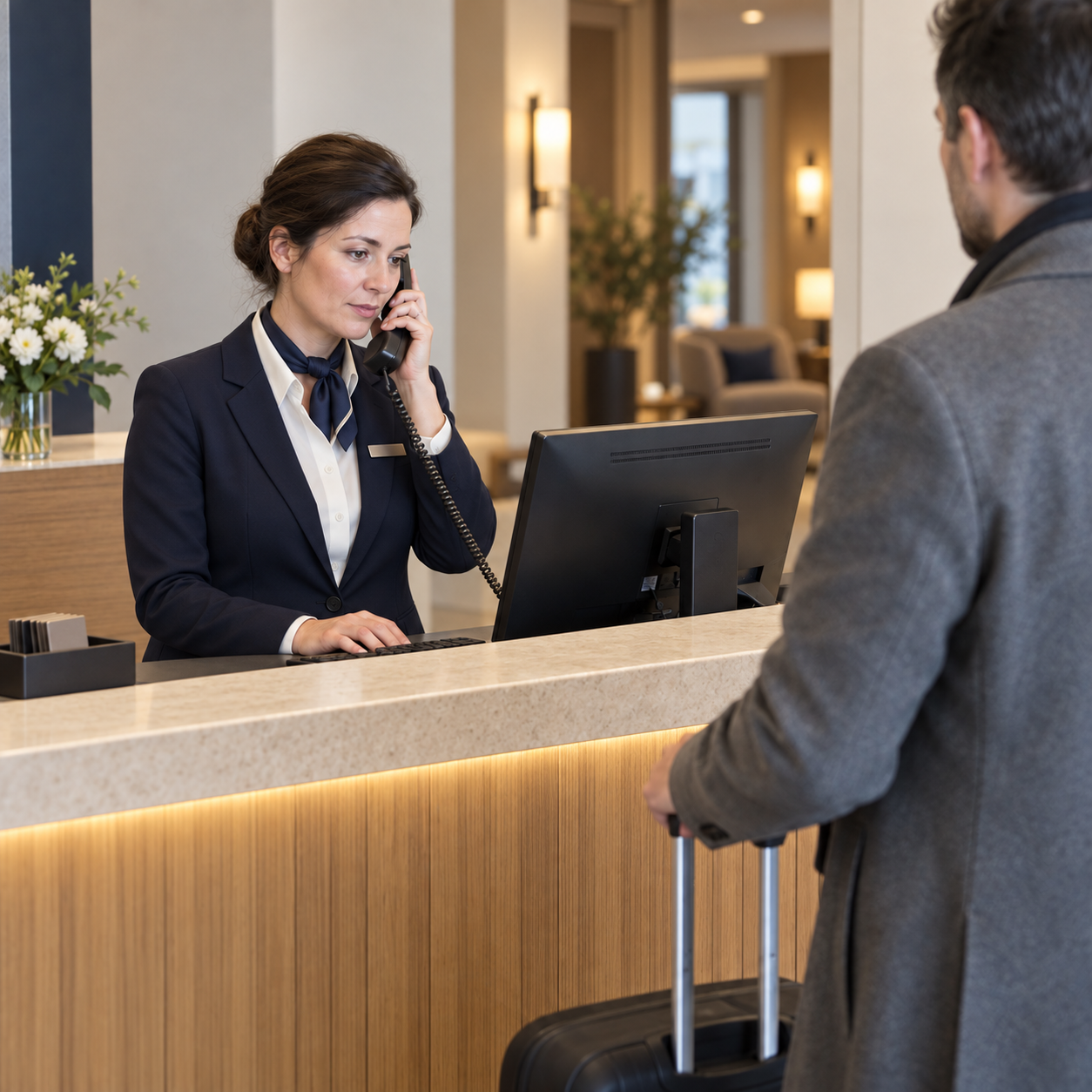
6:30 PM. A guest arrives, another is waiting to check in, the phone rings to ask about breakfast hours, and a second line calls to ask how to access the parking lot.
None of these requests are difficult. The problem lies in their accumulation.
Because of constant interruptions, the front desk spends part of its day relaying information that could often be available elsewhere.
Reducing calls to the front desk does not mean cutting off contact with guests. It is about reserving human interaction for situations where it truly adds value, while giving travelers easy access to the information they need.
Before trying to reduce calls, you need to understand why they are happening.
In many establishments, the information already exists. It is in the confirmation email, on a sign, in a room directory, or on the hotel website.
But when the guest actually needs it, they can't find it.
They then choose the easiest path: calling the front desk.
This behavior is logical. A traveler isn't trying to figure out where the hotel has hidden the information. They simply want to get an answer quickly.
The first step is therefore to analyze the calls received over a few days.
Simply categorize them into three groups:
This distinction is essential.
A call about a Wi-Fi password should often be avoidable. A call about broken air conditioning, however, should not.
The goal is therefore not to reduce all calls. The goal is to reduce those that do not need to be calls.
Some of the calls received during a stay can be avoided even before arrival.
Hotel access, parking, check-in times, breakfast, or late arrival procedures: some questions are predictable.
Rather than waiting for the guest to call, the hotel can provide this information exactly when it becomes useful.
A pre-stay email can, for example, prepare for the arrival a few days before the stay.
The same principle applies to registration.
When certain formalities are completed before arrival thanks to digital check-in, the front desk handles fewer administrative tasks when multiple guests arrive at once. GetWelcom specifically highlights the traditional check-in as a bottleneck where calls, paperwork, and wait times can all pile up simultaneously.
The right question to ask for every piece of information is therefore:
When is the guest likely to need this?
If the answer is "before they arrive," it shouldn't wait until they are standing at the front desk.
During their stay, some requests will remain inevitable.
But calling shouldn't be the only way to find out breakfast hours or how a service works.
This is where guest autonomy becomes important.
A Room Directory can centralize practical information and allow travelers to consult it whenever they need to.
The goal is not to remove the front desk from the guest journey. On the contrary: the more accessible simple answers are, the more available the front desk remains for meaningful interactions.
The GetWelcom article on the Room Directory explores this exact logic: when routine information is easy to find, interruptions decrease and staff can focus on more specific requests.
The essential point remains accessibility.
An exhaustive document that no one reads does not reduce call volume.
Information must be easy to find quickly, ideally from the guest's smartphone, without them having to download a new app or navigate through multiple pages.
For establishments looking to centralize this content, a digital Room Directory allows for QR code access and updates from a centralized back-office.
There is a counter-risk: being so focused on promoting self-service that the guest no longer knows how to reach someone when they truly need to.
That would be a mistake.
A room issue, a complaint, or an urgent situation should not lead to an endless loop of FAQs.
The journey must therefore offer two very clear paths:
"I'm looking for information" → self-service access.
"I need to speak to someone" → immediate contact with the team.
This is where the Room Directory and telephony are not competitors, but complementary.
The former reduces informational calls. The latter simplifies the calls that remain necessary.
With a VoIP hotel telephony solution, guests can contact the front desk from their smartphone, while the hotel chooses where the call should be routed: the switchboard, back-office, or a service phone.
The question is therefore not: "How can we stop the guest from calling?"
But rather:
"How can we ensure they only call when a conversation is truly necessary?"
Once simple requests are off the phone, a second task begins: managing the remaining ones more effectively.
Not all requests have the same priority.
A guest looking for a restaurant recommendation, another reporting a leak, and a third asking for an extra pillow do not require the same response or level of urgency.
The hotel can therefore rethink how it routes requests based on its internal organization.
Who should receive calls at night?
Should calls always go to the front desk?
Can a service team receive certain requests directly?
What information should be accessible without interrupting a receptionist already speaking with a guest?
This reflection ties into the broader way the hotel organizes its guest communication : the right channel depends on the timing and the type of need.
Reducing pressure on the front desk is less about "total automation" and more about better distributing interactions.
Setting up a QR code, sending more emails, or changing your phone system isn't enough.
You need to verify if these changes actually reduce repetitive requests.
A simple method is to compare, before and after the change:
If guests are still calling daily about parking even though the information is available, the problem is likely not that it's missing.
It might be sent too late, placed in the wrong spot, or phrased unclearly.
This analysis allows you to progressively improve the guest journey instead of constantly adding more materials.
The impact can be tangible. In their feedback on the Room Directory + VoIP rollout at Louvre Hotels Group, GetWelcom reports up to 30% fewer calls to the front desk, largely because guests find certain answers directly before reaching out to the team.
This approach also contributes to hotel guest satisfaction : a traveler appreciates finding simple information quickly just as much as being able to easily reach someone when a problem arises.
GetWelcom allows you to centralize stay information in a digital Room Directory and maintain direct contact with the front desk via VoIP telephony.
Request a GetWelcom demo