
E-réputation et communication
Why measure your hotel's NPS in 2026?
2
min de lecture
-
02 March 2026
A customer leaves your hotel satisfied. No negative feedback, no incidents reported.
Two days later, a review appeared online with a low rating.
This discrepancy is common in the hotel industry. It doesn't come from poor service, but from a lack of visibility into what customers are really thinking, at the right time.
The NPS hotel makes it possible to fill this void.
In 2026, it is no longer a “marketing indicator”. It is a concrete tool to understand its customers, anticipate opinions and manage the quality of service on a daily basis.
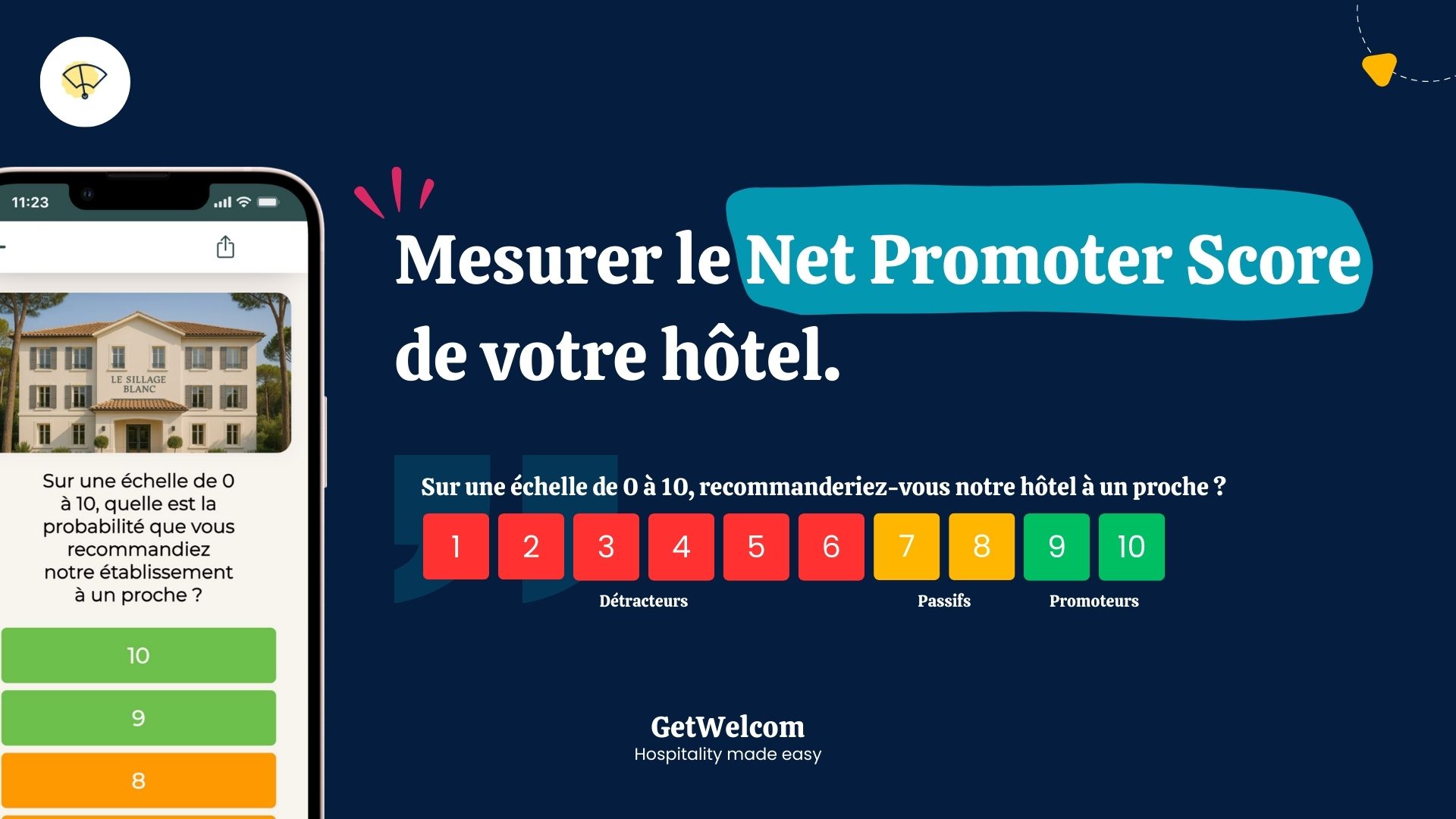
The Net Promoter Score is based on a single question: would you recommend this hotel to someone close to you.
It's fast, understandable, and above all easy to integrate into the customer journey.
Based on their response, customers are classified into three categories:
The score is the difference between promoters and detractors.
But in practice, what really matters is not the number.
That's what it reveals about your customer experience.
In the field, many hoteliers don't know how to interpret their score.
Here are some useful orders of magnitude:
The majority of hotels are between 20 and 40.
A “correct” score can therefore hide recurring problems.
Without analysing customer feedback, it remains difficult to exploit.
In many establishments, teams think that everything is going well simply because there are few complaints.
In reality, a large portion of dissatisfied customers say nothing on the spot.
Concrete example:
A hotel analyzes its NPS feedback and identifies several comments about noise in certain rooms.
No customer had complained about it at the reception.
The result: a real but invisible problem.
Once identified, it becomes possible to take action:
Here, the NPS becomes a very concrete tool to improve operations.
An unsatisfied customer is not necessarily going to complain.
But he will often leave a review after his stay.
This is where NPS monitoring is a game changer.
When a customer gives a low score, it is still possible to intervene:
In this context, NPS becomes a direct lever to improve your e-reputation hotel and better manage the hotel reviews.
A satisfied customer does not always leave a review.
Without solicitation, the majority of positive feedback remains silent.
The NPS makes it possible to precisely identify the most satisfied customers.
They are the ones who are most likely to recommend your establishment.
By asking them at the right time, you increase:
It is a direct lever on hotel reviews and therefore on your commercial performance.
NPS should not be used alone.
It is part of a global strategy for monitoring customer satisfaction and reviews.
Establishments that perform use NPS to:
This approach is detailed in the article on customer reviews in the hotel industry.
Sending an NPS only after the stay severely limits his interest.
The customer has already taken a step back, or even left a review.
The most advanced hotels use several moments:
This makes it possible to obtain more reliable and, above all, usable returns quickly.
The NPS becomes really useful when it is integrated into the daily life of teams.
In concrete terms, this may take a few minutes per day:
Then adjust:
In establishments that operate in this way, the NPS becomes a simple tool, without additional complexity, but with a real impact on the quality of service.
The hotel NPS is not just another indicator.
It is a tool that allows you to understand what your customers are really going through, at a time when it is still possible to act.
In 2026, the institutions that perform are the ones that use this data to adjust their operations, not those that just measure it.
Well exploited, the NPS makes it possible to improve satisfaction, to anticipate negative reviews and to sustainably strengthen the hotel's performance.



.png)